Gideon Stein, Niklas Penzel, Tristan Piater, Joachim Denzler:
TCD-Arena: Assessing Robustness of Time Series Causal Discovery Methods Against Assumption Violations.
International Conference on Learning Representations (ICLR).
2026.
[bibtex]
[web]
[abstract]
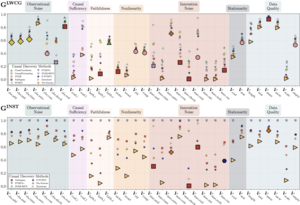
Causal Discovery (CD) is a powerful framework for scientific inquiry. Yet, its practical adoption is hindered by a reliance on strong, often unverifiable assumptions and a lack of robust performance assessment. To address these limitations and advance empirical CD evaluation, we present TCD-Arena, a modularized and extendable testing kit to assess the robustness of time series CD algorithms against stepwise more severe assumption violations. For demonstration, we conduct an extensive empirical study comprising arround 30 million individual CD attempts and reveal nuanced robustness profiles for 33 distinct assumption violations. Further, we investigate CD ensembles and find that they can boost general robustness, which has implications for real-world applications. With this, we strive to ultimately facilitate the development of CD methods that are reliable for a diverse range of synthetic and potentially real-world data conditions.

Ana E. Bonato Asato, Claudia Guimaraes-Steinicke, Gideon Stein, Berit Schreck, Teja Kattenborn, Anne Ebeling, Stefan Posch, Joachim Denzler, Tim Büchner, Maha Shadaydeh, Christian Wirth, Nico Eisenhauer, Jes Hines:
Seasonal Shifts in Plant Diversity Effects on Above-Ground-Below-Ground Phenological Synchrony.
Journal of Ecology.
113 (2) :
pp. 472-484.
2025.
[bibtex]
[pdf]
[web]
[doi]
[abstract]
The significance of biological diversity as a mechanism that optimizes niche breadth for resource acquisition and enhancing ecosystem functionality is well-established. However, a significant gap remains in exploring temporal niche breadth, particularly in the context of phenological aspects of community dynamics. This study takes a unique approach by examining plant phenology, which has traditionally been focused on above-ground assessments, and delving into the relatively unexplored realm of below-ground processes. As a result, the influence of biological diversity on the synchronization of above-ground and below-ground dynamics is brought to the forefront, providing a novel perspective on this complex relationship. In this study, community traits (including plant height and greenness) and soil processes (such as root growth and detritivore feeding activity) were meticulously monitored at 2-week intervals over a year within an experimental grassland exhibiting a spectrum of plant diversity, ranging from monocultures to 60-species mixtures. Our findings revealed that plant diversity increased yearly plant height, root growth and detritivore feeding activity, while enhancing the synchrony between above-ground traits and soil dynamics. Soil microclimate also played a role in shaping the phenology of these traits and processes. However, plant diversity and soil microclimate on above-ground traits and soil dynamics effects varied considerably in strength and direction across seasons, indicating a nuanced relationship between biodiversity, climate and ecosystem processes. Notably, observations during the growing season unveiled a sequential pattern wherein peak plant community height preceded the onset of greenness. Meanwhile, root production commenced immediately after leaf senescence and persisted throughout winter. Although consistent throughout the year, detritivore activity exhibited pronounced peaks in the summer and late fall, albeit with notable variability. Synthesis. The study underscores the dynamic interplay between plant diversity, above-ground–below-ground phenological patterns and ecosystem functioning. It suggests that plant diversity modulates above-ground–below-ground interdependence through intricate phenological dynamics, with the degree of synchrony fluctuating in response to the varying combination of processes and seasonal changes. Thus, by providing comprehensive within-year data, the research elucidates the fundamental disparities in phenological patterns across shoots, roots and soil fauna activities, thereby emphasizing the pivotal role of plant diversity in shaping ecosystem processes.

Gideon Stein, Maha Shadaydeh, Jan Blunk, Niklas Penzel, Joachim Denzler:
CausalRivers - Scaling Up Benchmarking of Causal Discovery for Real-world Time-series.
International Conference on Learning Representations (ICLR).
2025.
[bibtex]
[pdf]
[web]
[doi]
[abstract]
Causal discovery, or identifying causal relationships from observational data, is a notoriously challenging task, with numerous methods proposed to tackle it. Despite this, in-the-wild evaluation of these methods is still lacking, as works frequently rely on synthetic data evaluation and sparse real-world examples under critical theoretical assumptions. Real-world causal structures, however, are often complex, evolving over time, non-linear, and influenced by unobserved factors, making it hard to decide on a proper causal discovery strategy. To bridge this gap, we introduce CausalRivers, the largest in-the-wild causal discovery benchmarking kit for time-series data to date. CausalRivers features an extensive dataset on river discharge that covers the eastern German territory (666 measurement stations) and the state of Bavaria (494 measurement stations). It spans the years 2019 to 2023 with a 15-minute temporal resolution. Further, we provide additional data from a flood around the Elbe River, as an event with a pronounced distributional shift. Leveraging multiple sources of information and time-series meta-data, we constructed two distinct causal ground truth graphs (Bavaria and eastern Germany). These graphs can be sampled to generate thousands of subgraphs to benchmark causal discovery across diverse and challenging settings. To demonstrate the utility of CausalRivers, we evaluate several causal discovery approaches through a set of experiments to identify areas for improvement. CausalRivers has the potential to facilitate robust evaluations and comparisons of causal discovery methods. Besides this primary purpose, we also expect that this dataset will be relevant for connected areas of research, such as time-series forecasting and anomaly detection. Based on this, we hope to push benchmark-driven method development that fosters advanced techniques for causal discovery, as is the case for many other areas of machine learning.

Gideon Stein, Maha Shadaydeh, Joachim Denzler:
Embracing the Black Box: Heading Towards Foundation Models for Causal Discovery from Time Series Data.
AAAI Workshop on AI for Time-series (AAAI-WS).
2024.
[bibtex]
[pdf]
[web]
[abstract]
Causal discovery from time series data encompasses many existing solutions, including those based on deep learning techniques. However, these methods typically do not endorse one of the most prevalent paradigms in deep learning: End-to-end learning. To address this gap, we explore what we call Causal Pretraining. A methodology that aims to learn a direct mapping from multivariate time series to the underlying causal graphs in a supervised manner. Our empirical findings suggest that causal discovery in a supervised manner is possible, assuming that the training and test time series samples share most of their dynamics. More importantly, we found evidence that the performance of Causal Pretraining can increase with data and model size, even if the additional data do not share the same dynamics. Further, we provide examples where causal discovery for real-world data with causally pretrained neural networks is possible within limits. We argue that this hints at the possibility of a foundation model for causal discovery.

Gideon Stein, Sai Karthikeya Vemuri, Yuanyuan Huang, Anne Ebeling, Nico Eisenhauer, Maha Shadaydeh, Joachim Denzler:
Investigating the Effects of Plant Diversity on Soil Thermal Diffusivity Using Physics- Informed Neural Networks.
ICLR Workshop on AI4DifferentialEquations In Science (ICLR-WS).
2024.
[bibtex]
[pdf]
[web]
[abstract]
The influence of plant diversity on the stability of ecosystems is well-reported in the literature. However, the exact mechanisms responsible for this effect are still a topic of debate. Recently, soil temperature stability was proposed as one possible candidate for such a mechanism. To further evaluate this hypothesis, we investigate the relationship between plant diversity and the thermal diffusivity of the soil during the very dry and hot summer of 2018 in Central Europe. By leveraging Physics-Informed Neural Networks and a 30-minute resolution soil temperature dataset from the Jena Experiment, we find an inverse relationship between plant diversity and the thermal diffusivity of the associated soil. With this, we provide support for the idea of plant diversity as a natural protection against climate-related ecosystem change.
Yuanyuan Huang, Gideon Stein, Olaf Kolle, Karl Kuebler, Ernst-Detlef Schulze, Hui Dong, David Eichenberg, Gerd Gleixner, Anke Hildebrandt, Markus Lange, Christiane Roscher, Holger Schielzeth, Bernhard Schmid, Alexandra Weigelt, Wolfgang W. Weisser, Maha Shadaydeh, Joachim Denzler, Anne Ebeling, Nico Eisenhauer:
Enhanced Stability of Grassland Soil Temperature by Plant Diversity.
Nature Geoscience.
pp. 1-7.
2023.
[bibtex]
[doi]
[abstract]
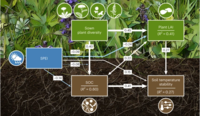
Extreme weather events are occurring more frequently, and research has shown that plant diversity can help mitigate the impacts of climate change by increasing plant productivity and ecosystem stability. Although soil temperature and its stability are key determinants of essential ecosystem processes, no study has yet investigated whether plant diversity buffers soil temperature fluctuations over long-term community development. Here we have conducted a comprehensive analysis of a continuous 18-year dataset from a grassland biodiversity experiment with high spatial and temporal resolutions. Our findings reveal that plant diversity acts as a natural buffer, preventing soil heating in hot weather and cooling in cold weather. This diversity effect persists year-round, intensifying with the aging of experimental communities and being even stronger under extreme climate conditions, such as hot days or dry years. Using structural equation modelling, we found that plant diversity stabilizes soil temperature by increasing soil organic carbon concentrations and, to a lesser extent, plant leaf area index. Our results suggest that, in lowland grasslands, the diversity-induced stabilization of soil temperature may help to mitigate the negative effects of extreme climatic events such as soil carbon decomposition, thus slowing global warming.