Jonas Ziemer, Gideon Stein, Carolin Wicker, Jannik Jänichen, Daniel Klöpper, Katja Last, Joachim Denzler, Christiane Schmullius, Maha Shadaydeh, Clémence Dubois:
Enhancing the Prediction of Dam Deformations: A Novel Data-Driven Approach.
Remote Sensing.
17 (6) :
2025.
[bibtex]
[pdf]
[doi]
[abstract]
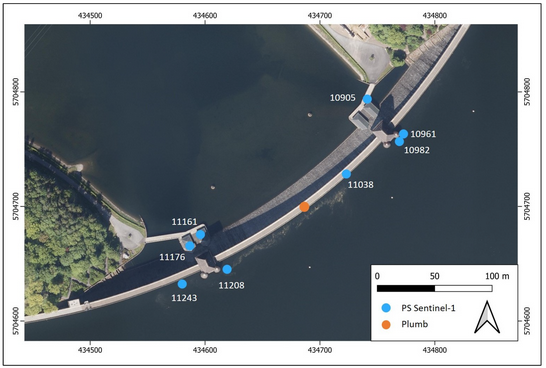
Deformation monitoring is a critical task for dam operators to guarantee safe operation. Given an increasing number of extreme weather events caused by climate change, the precise prediction of dam deformations has become increasingly important. Traditionally, multiple linear regression models have been employed, utilizing in situ data from pendulum systems or trigonometric measurements. These methods sometimes suffer from sparse data, which typically represent deformations only at specific points on the dam, if such data are available at all. Technical advances in multi-temporal synthetic aperture radar interferometry (MT-InSAR), particularly Persistent Scatterer Interferometry (PSI), address these limitations by enabling monitoring in high spatial and temporal resolution, capturing dam deformations with millimeter precision, and providing extensive spatial coverage. This study advances traditional methods of dam monitoring by employing data-driven techniques and integrating Sentinel-1 C-band Persistent Scatterer (PS) time series alongside in situ data. Through a comprehensive evaluation of advanced data-driven approaches, we demonstrated considerable improvements in predicting dam deformations and evaluating their drivers. The analysis provided evidence for the following insights: First, the accuracy of current modeling approaches can be greatly improved by utilizing advanced feature engineering and data-driven model selection. The prediction performance of the pendulum data was improved by utilizing data-driven algorithms, reducing the mean absolute error from 0.51 mm in the baseline model (R2 = 0.92) to as low as 0.05 mm using the full model search space (R2 = 0.99). Although the model accuracy for the PS datasets (MAEmax: 0.81 mm) was about one order of magnitude lower than that for pendulum data, the mean absolute errors could be reduced by up to 0.25 mm. Second, by incorporating freely available PS time series into deformation prediction, dams can be monitored in higher spatial resolution, making PSI a valuable tool for dam operators. This requires adequate dataset filtering to eliminate noisy PS points. Third, extended representations of water level and temperature, including interaction effects, can improve model accuracy and reduce prediction errors. With these insights, we recommend incorporating the proposed methodology into the monitoring program of gravity dams to enhance the accuracy in predicting their expected deformations.

Jonas Ziemer, Jannik Jänichen, Gideon Stein, Natascha Liedel, Carolin Wicker, Katja Last, Joachim Denzler, Christiane Schmullius, Maha Shadaydeh, Clémence Dubois:
Identifying Deformation Drivers in Dam Segments Using Combined X- and C-Band PS Time Series.
Remote Sensing.
17 (15) :
2025.
[bibtex]
[doi]
[abstract]
Dams play a vital role in securing water and electricity supplies for households and industry, and they contribute significantly to flood protection. Regular monitoring of dam deformations holds fundamental socio-economic and ecological importance. Traditionally, this has relied on time-consuming in situ techniques that offer either high spatial or temporal resolution. Persistent Scatterer Interferometry (PSI) addresses these limitations, enabling high-resolution monitoring in both domains. Sensors such as TerraSAR-X (TSX) and Sentinel-1 (S-1) have proven effective for deformation analysis with millimeter accuracy. Combining TSX and S-1 datasets enhances monitoring capabilities by leveraging the high spatial resolution of TSX with the broad coverage of S-1. This improves monitoring by increasing PS point density, reducing revisit intervals, and facilitating the detection of environmental deformation drivers. This study aims to investigate two objectives: first, we evaluate the benefits of a spatially and temporally densified PS time series derived from TSX and S-1 data for detecting radial deformations in individual dam segments. To support this, we developed the TSX2StaMPS toolbox, integrated into the updated snap2stamps workflow for generating single-master interferogram stacks using TSX data. Second, we identify deformation drivers using water level and temperature as exogenous variables. The five-year study period (2017–2022) was conducted on a gravity dam in North Rhine-Westphalia, Germany, which was divided into logically connected segments. The results were compared to in situ data obtained from pendulum measurements. Linear models demonstrated a fair agreement between the combined time series and the pendulum data (𝑅2 = 0.5; MAE = 2.3 mm). Temperature was identified as the primary long-term driver of periodic deformations of the gravity dam. Following the filling of the reservoir, the variance in the PS data increased from 0.9 mm to 3.9 mm in RMSE, suggesting that water level changes are more responsible for short-term variations in the SAR signal. Upon full impoundment, the mean deformation amplitude decreased by approximately 1.7 mm toward the downstream side of the dam, which was attributed to the higher water pressure. The last five meters of water level rise resulted in higher feature importance due to interaction effects with temperature. The study concludes that integrating multiple PS datasets for dam monitoring is beneficial particularly for dams where few PS points can be identified using one sensor or where pendulum systems are not installed. Identifying the drivers of deformation is feasible and can be incorporated into existing monitoring frameworks.

Gideon Stein, Jonas Ziemer, Carolin Wicker, Jannik Jaenichen, Gabriele Demisch, Daniel Kloepper, Katja Last, Joachim Denzler, Christiane Schmullius, Maha Shadaydeh, Clémence Dubois:
Data-driven Prediction of Large Infrastructure Movements Through Persistent Scatterer Time Series Modeling.
IEEE International Geoscience and Remote Sensing Symposium (IGARSS).
pp. 8669-8673.
2024.
[bibtex]
[pdf]
[doi]
[abstract]
Deformation monitoring is a crucial task for dam operators, particularly given the rise in extreme weather events associated with climate change. Further, quantifying the expected deformations of a dam is a central part of this endeavor. Current methods rely on in situ data (i.e., water level and temperature) to predict the expected deformations of a dam (typically represented by plumb or trigonometric measurements). However, not all dams are equipped with extensive measurement techniques, resulting in infrequent monitoring. Persistent Scatterer Interferometry (PSI) can overcome this limitation, enabling an alternative monitoring scheme for such infrastructures. This study introduces a novel monitoring approach to quantify expected deformations of gravity dams in Germany by integrating the PSI technique with in situ data. Further, it proposes a methodology to find proper statistical representations in a data-driven manner, which extends established statistical approaches. The approach demonstrates plausible deformation patterns as well as accurate predictions for validation data (mean absolute error=1.81 mm), confirming the benefits of the proposed method.