Aishwarya Venkataramanan, Sai Karthikeya Vemuri, Joachim Denzler:
APIC: Amortized Physics-Informed Calibration using Neural Processes.
Conference on Uncertainty in Artificial Intelligence (UAI).
2026.
(accepted)
[bibtex]
[doi]
[code]
[abstract]
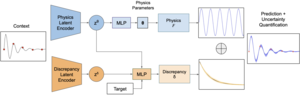
Physics models are inherently imperfect due to misspecified or missing mechanisms, resulting in systematic discrepancies between model predictions and real-world observations. The Kennedy-O'Hagan (KOH) framework addresses this issue through explicit discrepancy modeling. However, its non-amortized, per-instance formulation limits scalability across families of related systems. We introduce Amortized Physics-Informed Calibration (APIC), a population-level extension of KOH that leverages Neural Processes to perform scalable Bayesian inference across realizations. Our framework employs a two-branch latent architecture to disentangle instance-specific physical parameters from shared, state-dependent structural discrepancies. By integrating differentiable physics into an amortized inference backbone, APIC enables rapid calibration of unseen realizations from sparse observations while quantifying uncertainty. Experiments on the damped spring oscillator, the Lotka-Volterra system, and the advection-diffusion PDE with misspecified physics demonstrate improved parameter recovery and consistent identification of the systemic discrepancy structure compared to other calibration approaches.

Sai Karthikeya Vemuri, Adithya Ashok Chalain Valapil, Tim Büchner, Joachim Denzler:
RamPINN: Recovering Raman Spectra From Coherent Anti-Stokes Spectra Using Embedded Physics.
International Conference on Artificial Intelligence and Statistics (AISTATS).
2026.
[bibtex]
[pdf]
[doi]
[abstract]
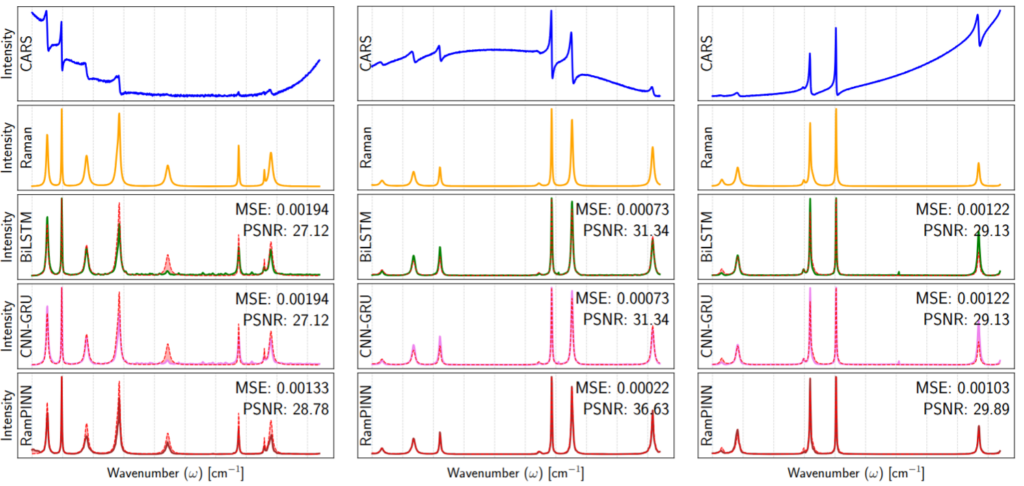
Transferring the recent advancements in deep learning into scientific disciplines is hindered by the lack of the required large-scale datasets for training. We argue that in these knowledge-rich domains, the established body of scientific theory provides reliable inductive biases in the form of governing physical laws. We address the ill-posed inverse problem of recovering Raman spectra from noisy Coherent Anti-Stokes Raman Scattering (CARS) measurements, as the true Raman signal here is suppressed by a dominating non-resonant background. We propose RamPINN, a model that learns to recover Raman spectra from given CARS spectra. Our core methodological contribution is a physics-informed neural network that utilizes a dual-decoder architecture to disentangle resonant and non-resonant signals. This is done by enforcing the Kramers-Kronig causality relations via a differentiable Hilbert transform loss on the resonant and a smoothness prior on the non-resonant part of the signal. Trained entirely on synthetic data, RamPINN demonstrates strong zero-shot generalization to real-world experimental data, explicitly closing this gap and significantly outperforming existing baselines. Furthermore, we show that training with these physics-based losses alone, without access to any ground-truth Raman spectra, still yields competitive results. This work highlights a broader concept: formal scientific rules can act as a potent inductive bias, enabling robust, self-supervised learning in data-limited scientific domains.
Sai Karthikeya Vemuri, Tim Büchner, Joachim Denzler:
F-INR: Functional Tensor Decomposition for Implicit Neural Representations.
Winter Conference on Applications of Computer Vision (WACV).
2026.
[bibtex]
[web]
[doi]
[abstract]
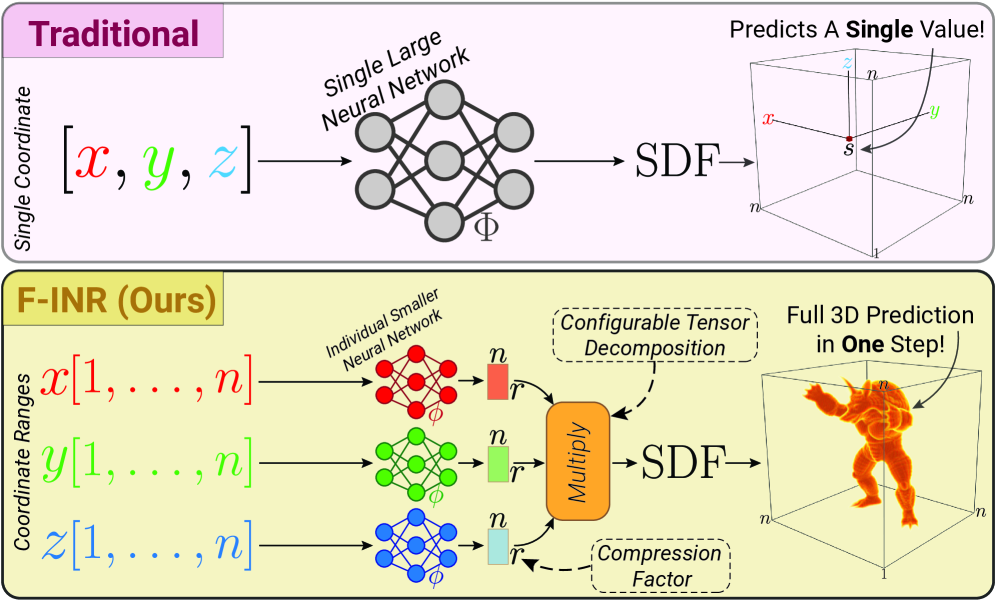
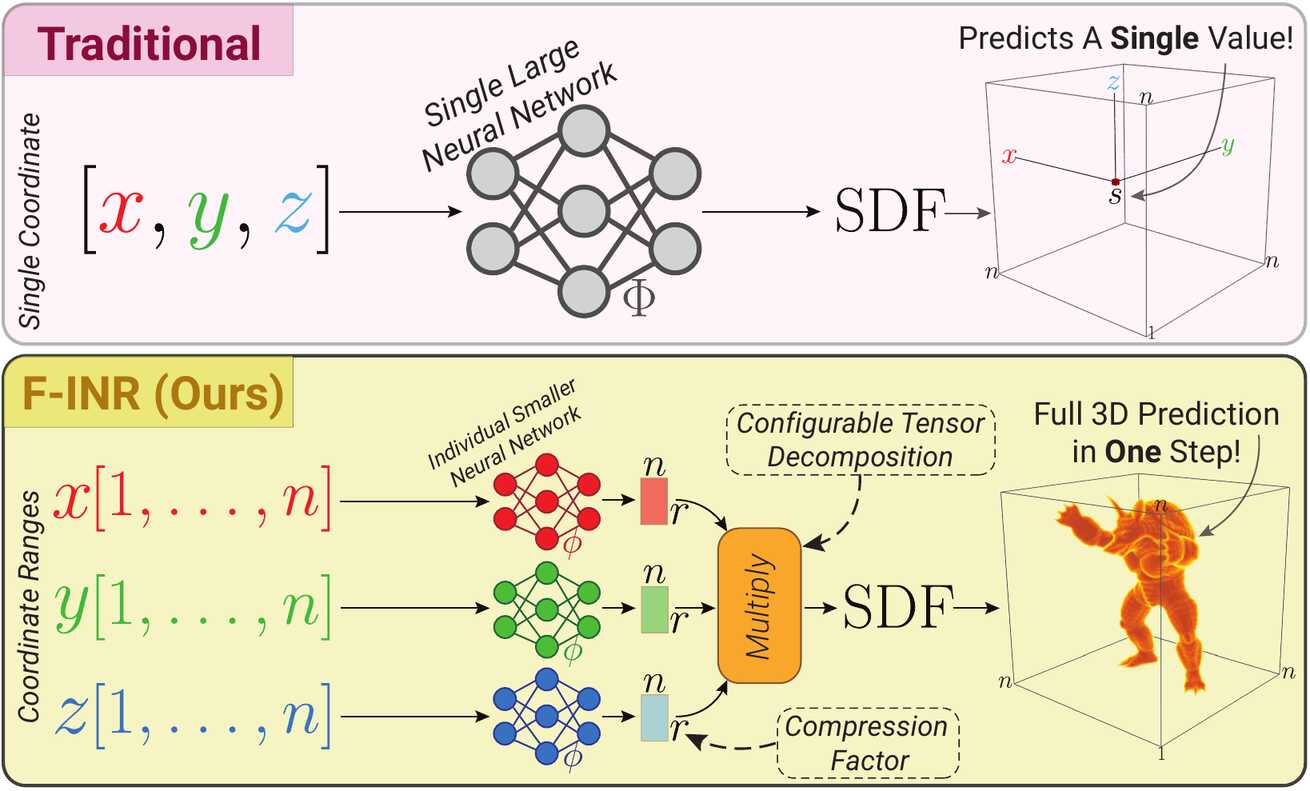
Implicit Neural Representations (INRs) model signals as continuous, differentiable functions. However, monolithic INRs scale poorly with data dimensionality, leading to excessive training costs. We propose F-INR, a framework that addresses this limitation by factorizing a high-dimensional INR into a set of compact, axis-specific sub-networks based on functional tensor decomposition. These sub-networks learn low-dimensional functional components that are then combined via tensor operations. This factorization reduces computational complexity while additionally improving representational capacity. F-INR is both architecture- and decomposition-agnostic. It integrates with various existing INR backbones (e.g., SIREN, WIRE, FINER, Factor Fields) and tensor formats (e.g., CP, TT, Tucker), offering fine-grained control over the speed-accuracy trade-off via the tensor rank and mode. Our experiments show F-INR accelerates training by up to and improves fidelity by over 6.0 dB PSNR compared to state-of-the-art INRs. We validate these gains on diverse tasks, including image representation, 3D geometry reconstruction, and neural radiance fields. We further show F-INR's applicability to scientific computing by modeling complex physics simulations. Thus, F-INR provides a scalable, flexible, and efficient framework for high-dimensional signal modeling.
Sai Karthikeya Vemuri, Tim Büchner, Julia Niebling, Joachim Denzler:
Scalable and Expressive Physics-Informed Neural Networks via Functional Tensor Decomposition.
Pattern Recognition Letters.
2026.
[bibtex]
[pdf]
[web]
[doi]
[code]
[abstract]
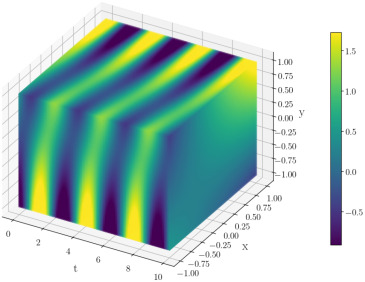
Physics-Informed Neural Networks (PINNs) offer a promising framework for solving partial differential equations (PDEs) by embedding physical laws into neural network training. In our prior work, we introduced Functional Tensor Decomposition PINNs (FTD-PINNs), which leverage tensor decomposition to improve the scalability and efficiency of PINNs, especially for high-dimensional PDEs. This work extends our previous study on Functional Tensor Decomposition PINNs by systematically examining how decomposition structure and backend activations affect performance, efficiency, and stability across representative partial differential equations. Using Helmholtz and Klein-Gordon systems as benchmarks, we compare three decomposition modes (CP, Tucker, Tensor-Train) combined with four activation backends (Tanh, Tanh + PE, SIREN, and WIRE). Multi-seed and compute-aware evaluations reveal consistent accuracy-efficiency trade-offs: Tensor-Train provides the most balanced decomposition, while frequency-aware backends such as WIRE and SIREN improve convergence for oscillatory regimes. Pareto analyses across rank and collocation density highlight a clear inflection point of diminishing returns and show that backend choice shifts the optimal configuration across PDE types. Together, these results extend the original FTD-PINN framework with a broader empirical foundation and provide practical guidance for selecting decomposition ranks, collocation densities, and backend activations for efficient PINN design.
Phillip Rothenbeck, Sai Karthikeya Vemuri, Niklas Penzel, Joachim Denzler:
Modeling COVID-19 Dynamics in German States Using Physics-Informed Neural Networks.
EurIPS Workshop on Differentiable Systems and Scientific Machine Learning (EurIPS-WS).
2025.
[bibtex]
[pdf]
[doi]
[abstract]
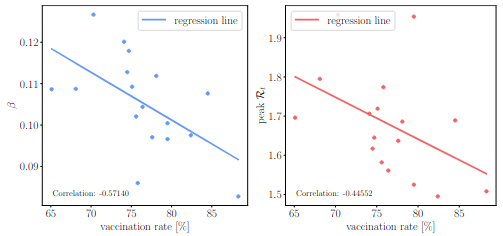
The COVID-19 pandemic has highlighted the need for quantitative modeling and analysis to understand real-world disease dynamics. In particular, post hoc analyses using compartmental models offer valuable insights into the effectiveness of public health interventions, such as vaccination strategies and containment policies. However, such compartmental models like SIR (Susceptible-Infectious-Recovered) often face limitations in directly incorporating noisy observational data. In this work, we employ Physics-Informed Neural Networks (PINNs) to solve the inverse problem of the SIR model using infection data from the Robert Koch Institute (RKI). Our main contribution is a fine-grained, spatio-temporal analysis of COVID-19 dynamics across all German federal states over a three-year period. We estimate state-specific transmission and recovery parameters and time-varying reproduction number (R\_t) to track the pandemic progression. The results highlight strong variations in transmission behavior across regions, revealing correlations with vaccination uptake and temporal patterns associated with major pandemic phases. Our findings demonstrate the utility of PINNs in localized, long-term epidemiological modeling.

Gideon Stein, Sai Karthikeya Vemuri, Yuanyuan Huang, Anne Ebeling, Nico Eisenhauer, Maha Shadaydeh, Joachim Denzler:
Investigating the Effects of Plant Diversity on Soil Thermal Diffusivity Using Physics- Informed Neural Networks.
ICLR Workshop on AI4DifferentialEquations In Science (ICLR-WS).
2024.
[bibtex]
[pdf]
[web]
[abstract]
The influence of plant diversity on the stability of ecosystems is well-reported in the literature. However, the exact mechanisms responsible for this effect are still a topic of debate. Recently, soil temperature stability was proposed as one possible candidate for such a mechanism. To further evaluate this hypothesis, we investigate the relationship between plant diversity and the thermal diffusivity of the soil during the very dry and hot summer of 2018 in Central Europe. By leveraging Physics-Informed Neural Networks and a 30-minute resolution soil temperature dataset from the Jena Experiment, we find an inverse relationship between plant diversity and the thermal diffusivity of the associated soil. With this, we provide support for the idea of plant diversity as a natural protection against climate-related ecosystem change.

Sai Karthikeya Vemuri, Tim Büchner, Joachim Denzler:
Estimating Soil Hydraulic Parameters for Unsaturated Flow using Physics-Informed Neural Networks.
International Conference on Computational Science (ICCS).
Pages 338-351.
2024.
[bibtex]
[pdf]
[doi]
[abstract]
Water movement in soil is essential for weather monitoring, prediction of natural disasters, and agricultural water management. Richardson-Richards' equation (RRE) is the characteristic partial differential equation for studying soil water movement. RRE is a non-linear PDE involving water potential, hydraulic conductivity, and volumetric water content. This equation has underlying non-linear parametric relationships called water retention curves (WRCs) and hydraulic conductivity functions (HCFs). This two-level non-linearity makes the problem of unsaturated water flow of soils challenging to solve. Physics-Informed Neural Networks (PINNs) offer a powerful paradigm to combine physics in data-driven techniques. From noisy or sparse observations of one variable (water potential), we use PINNs to learn the complete system, estimate the parameters of the underlying model, and further facilitate the prediction of infiltration and discharge. We employ training on RRE, WRC, HCF, and measured values to resolve two-level non-linearity directly instead of explicitly deriving water potential or volumetric water content-based formulations. The parameters to be estimated are made trainable with initialized values. We take water potential data from simulations and use this data to solve the inverse problem with PINN and compare estimated parameters, volumetric water content, and hydraulic conductivity with actual values. We chose different types of parametric relationships and wetting conditions to show the approach's effectiveness.

Sai Karthikeya Vemuri, Tim Büchner, Julia Niebling, Joachim Denzler:
Functional Tensor Decompositions for Physics-Informed Neural Networks.
International Conference on Pattern Recognition (ICPR).
Pages 32-46.
2024.
Best Paper Award
[bibtex]
[pdf]
[web]
[doi]
[code]
[abstract]
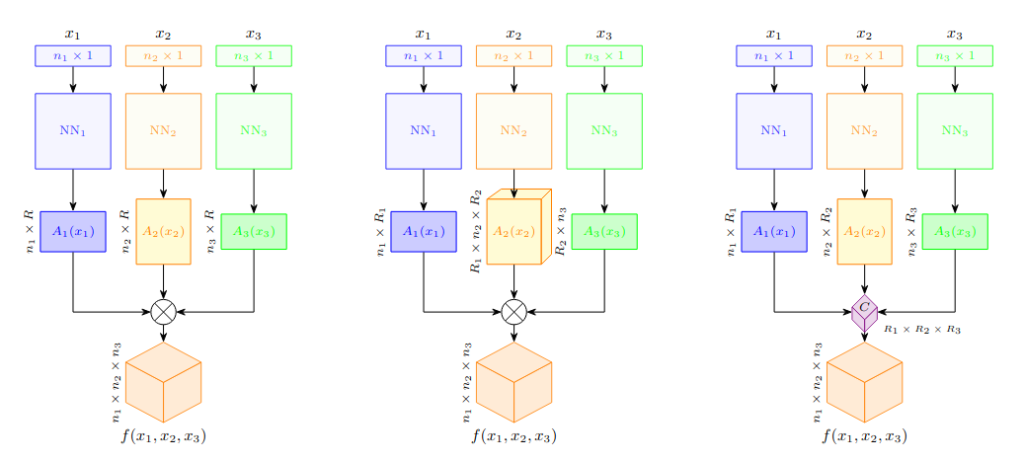
Physics-Informed Neural Networks (PINNs) have shown continuous promise in approximating partial differential equations (PDEs), although they remain constrained by the curse of dimensionality. In this paper, we propose a generalized PINN version of the classical variable separable method. To do this, we first show that, using the universal approximation theorem, a multivariate function can be approximated by the outer product of neural networks, whose inputs are separated variables. We leverage tensor decomposition forms to separate the variables in a PINN setting. By employing Canonic Polyadic (CP), Tensor-Train (TT), and Tucker decomposition forms within the PINN framework, we create robust architectures for learning multivariate functions from separate neural networks connected by outer products. Our methodology significantly enhances the performance of PINNs, as evidenced by improved results on complex high-dimensional PDEs, including the 3d Helmholtz and 5d Poisson equations, among others. This research underscores the potential of tensor decomposition-based variably separated PINNs to surpass the state-of-the-art, offering a compelling solution to the dimensionality challenge in PDE approximation.
Sai Karthikeya Vemuri, Joachim Denzler:
Physics Informed Neural Networks for Aeroacoustic Source Estimation.
IACM Mechanistic Machine Learning and Digital Engineering for Computational Science Engineering and Technology.
2023.
[bibtex]
[web]
[doi]
[abstract]
Computational Aeroacoustics (CAA) is a critical domain within computational fluid dynamics (CFD) that focuses on understanding and predicting sound generation in aerodynamic systems. Accurate estimation of Lighthill sources, which play a pivotal role in deciphering acoustic phenomena, remains a challenging task, especially when confronted with noisy and missing flow data. This study explores the potential of Physics Informed Neural Networks (PINNs) to address these challenges and capture the complex flow dynamics inherent in CAA. The integration of PINNs in CFD has gained significant attention in recent years. PINNs blend deep learning techniques with fundamental physical principles, enabling accurate predictions and enhanced modeling capabilities. Their versatility has been demonstrated across various CFD applications, ranging from turbulence modeling to flow control optimization and mesh generation. However, their potential in the field of CAA, specifically in estimating Lighthill sources from flow data, remains largely unexplored. To investigate the effectiveness of PINNs in the context of CAA, we conduct a series of experiments using high-fidelity flow data obtained from common flow configurations, such as flow around a cylinder. Leveraging this data, we create three distinct datasets that represent different data imperfections. The first dataset involves the deliberate removal of certain data points, the second dataset incorporates the addition of random noise, and the third dataset combines both missing data and noise. By incorporating the governing Navier-Stokes equations, we train the PINNs using these three datasets. The PINNs, with their inherent capability to capture complex flow patterns, are employed to estimate the aeroacoustic source map. The predicted map obtained from the PINNs is then rigorously compared to the ground truth source map derived from the high-fidelity data. Through these experiments, we demonstrate the remarkable ability of PINNs to effectively estimate the aeroacoustic source map in the presence of noisy and missing data. This validation establishes the potential of PINNs as a powerful tool for aeroacoustic analysis and source characterization. The successful application of PINNs in this study opens up new ways for further advancements in aeroacoustics. By leveraging PINNs we can enhance noise reduction techniques, optimize design processes, and improve the overall efficiency of aerodynamic systems. In conclusion, this research showcases the potential of Physics Informed Neural Networks for accurate aeroacoustic source estimation in scenarios where data quality is compromised. These findings contribute to the growing body of knowledge in aeroacoustics and offer a pathway toward more robust and efficient analysis techniques in the field.