Aishwarya Venkataramanan, Sai Karthikeya Vemuri, Joachim Denzler:
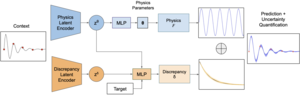
APIC: Amortized Physics-Informed Calibration using Neural Processes.
Conference on Uncertainty in Artificial Intelligence (UAI).
2026.
(accepted)
[bibtex]
[doi]
[code]
[abstract]
Physics models are inherently imperfect due to misspecified or missing mechanisms, resulting in systematic discrepancies between model predictions and real-world observations. The Kennedy-O'Hagan (KOH) framework addresses this issue through explicit discrepancy modeling. However, its non-amortized, per-instance formulation limits scalability across families of related systems. We introduce Amortized Physics-Informed Calibration (APIC), a population-level extension of KOH that leverages Neural Processes to perform scalable Bayesian inference across realizations. Our framework employs a two-branch latent architecture to disentangle instance-specific physical parameters from shared, state-dependent structural discrepancies. By integrating differentiable physics into an amortized inference backbone, APIC enables rapid calibration of unseen realizations from sparse observations while quantifying uncertainty. Experiments on the damped spring oscillator, the Lotka-Volterra system, and the advection-diffusion PDE with misspecified physics demonstrate improved parameter recovery and consistent identification of the systemic discrepancy structure compared to other calibration approaches.
Aishwarya Venkataramanan, Joachim Denzler:
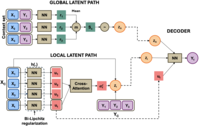
Distance-informed Neural Processes.
Annual Conference on Neural Information Processing Systems (NeurIPS).
2025.
[bibtex]
[web]
[doi]
[code]
[abstract]
We propose the Distance-informed Neural Process (DNP), a novel variant of Neural Processes that improves uncertainty estimation by combining global and distance-aware local latent structures. Standard Neural Processes (NPs) often rely on a global latent variable and struggle with uncertainty calibration and capturing local data dependencies. DNP addresses these limitations by introducing a global latent variable to model task-level variations and a local latent variable to capture input similarity within a distance-preserving latent space. This is achieved through bi-Lipschitz regularization, which bounds distortions in input relationships and encourages the preservation of relative distances in the latent space. This modeling approach allows DNP to produce better-calibrated uncertainty estimates and more effectively distinguish in- from out-of-distribution data. Empirical results demonstrate that DNP achieves strong predictive performance and improved uncertainty calibration across regression and classification tasks.

Aishwarya Venkataramanan, Paul Bodesheim, Joachim Denzler:
Probabilistic Embeddings for Frozen Vision-Language Models: Uncertainty Quantification with Gaussian Process Latent Variable Models.
Conference on Uncertainty in Artificial Intelligence (UAI).
Pages 4309-4328.
2025.
[bibtex]
[web]
[doi]
[code]
[abstract]
Vision-Language Models (VLMs) learn joint representations by mapping images and text into a shared latent space. However, recent research highlights that deterministic embeddings from standard VLMs often struggle to capture the uncertainties arising from the ambiguities in visual and textual descriptions and the multiple possible correspondences between images and texts. Existing approaches tackle this by learning probabilistic embeddings during VLM training, which demands large datasets and does not leverage the powerful representations already learned by large-scale VLMs like CLIP. In this paper, we propose GroVE, a post-hoc approach to obtaining probabilistic embeddings from frozen VLMs. GroVE builds on Gaussian Process Latent Variable Model (GPLVM) to learn a shared low-dimensional latent space where image and text inputs are mapped to a unified representation, optimized through single-modal embedding reconstruction and cross-modal alignment objectives. Once trained, the Gaussian Process model generates uncertainty-aware probabilistic embeddings. Evaluation shows that GroVE achieves state-of-the-art uncertainty calibration across multiple downstream tasks, including cross-modal retrieval, visual question answering, and active learning.
Aishwarya Venkataramanan, Sai Karthikeya Vemuri, Adithya Ashok Chalain Valapil, Joachim Denzler:
Uncertainty-aware Physics-informed Neural Networks for Robust CARS-to-Raman Signal Reconstruction.
EurIPS Workshop on Differentiable Systems and Scientific Machine Learning (EurIPS-WS).
2025.
[bibtex]
[abstract]
Coherent anti-Stokes Raman scattering (CARS) spectroscopy is a powerful and rapid technique widely used in medicine, material science, and chemical analyses. However, its effectiveness is hindered by the presence of a non-resonant background that interferes with and distorts the true Raman signal. Deep learning methods have been employed to reconstruct the true Raman spectrum from measured CARS data using labeled datasets. A more recent development integrates the domain knowledge of Kramers-Kronig relationships and smoothness constraints in the form of physics-informed loss functions. However, these deterministic models lack the ability to quantify uncertainty, an essential feature for reliable deployment in high-stakes scientific and biomedical applications. In this work, we evaluate and compare various uncertainty quantification (UQ) techniques within the context of CARS-to-Raman signal reconstruction. Furthermore, we demonstrate that incorporating physics-informed constraints into these models improves their calibration, offering a promising path toward more trustworthy CARS data analysis.