Dennis Böttger, Peter Grobe, Christian Bräunig, Paul Bodesheim, Joachim Denzler, Jorrit van Gils, Julie Koch Sheard, Corinne Jampou, Roel van Klink, Gunnar Brehm:
LEPMON: Recording the biodiversity of moths (Lepidoptera) with automated cameras and artificial intelligence.
ARPHA Preprints.
2026.
[bibtex]
[pdf]
[web]
[doi]
[abstract]
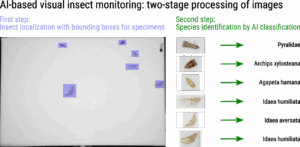
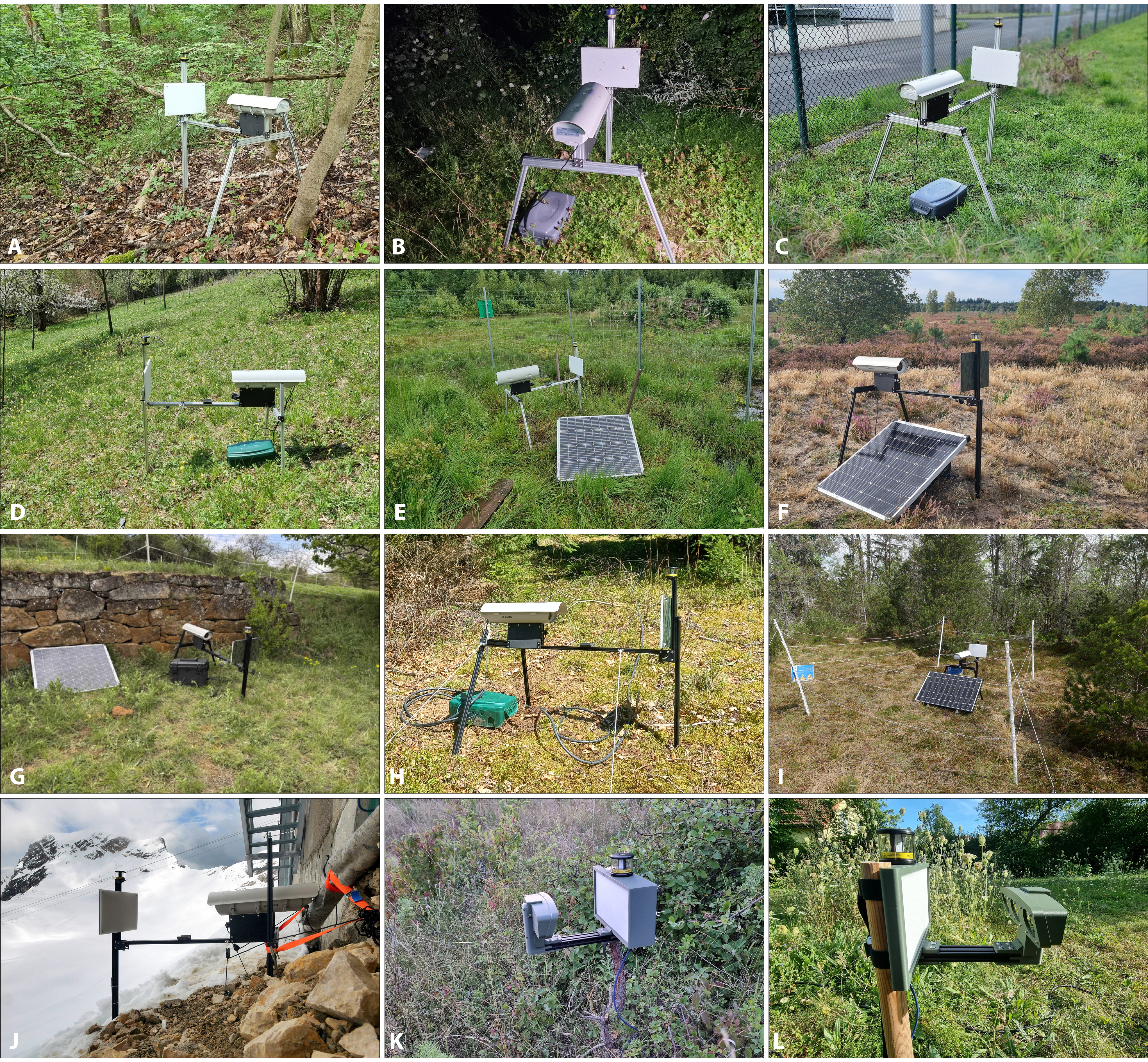
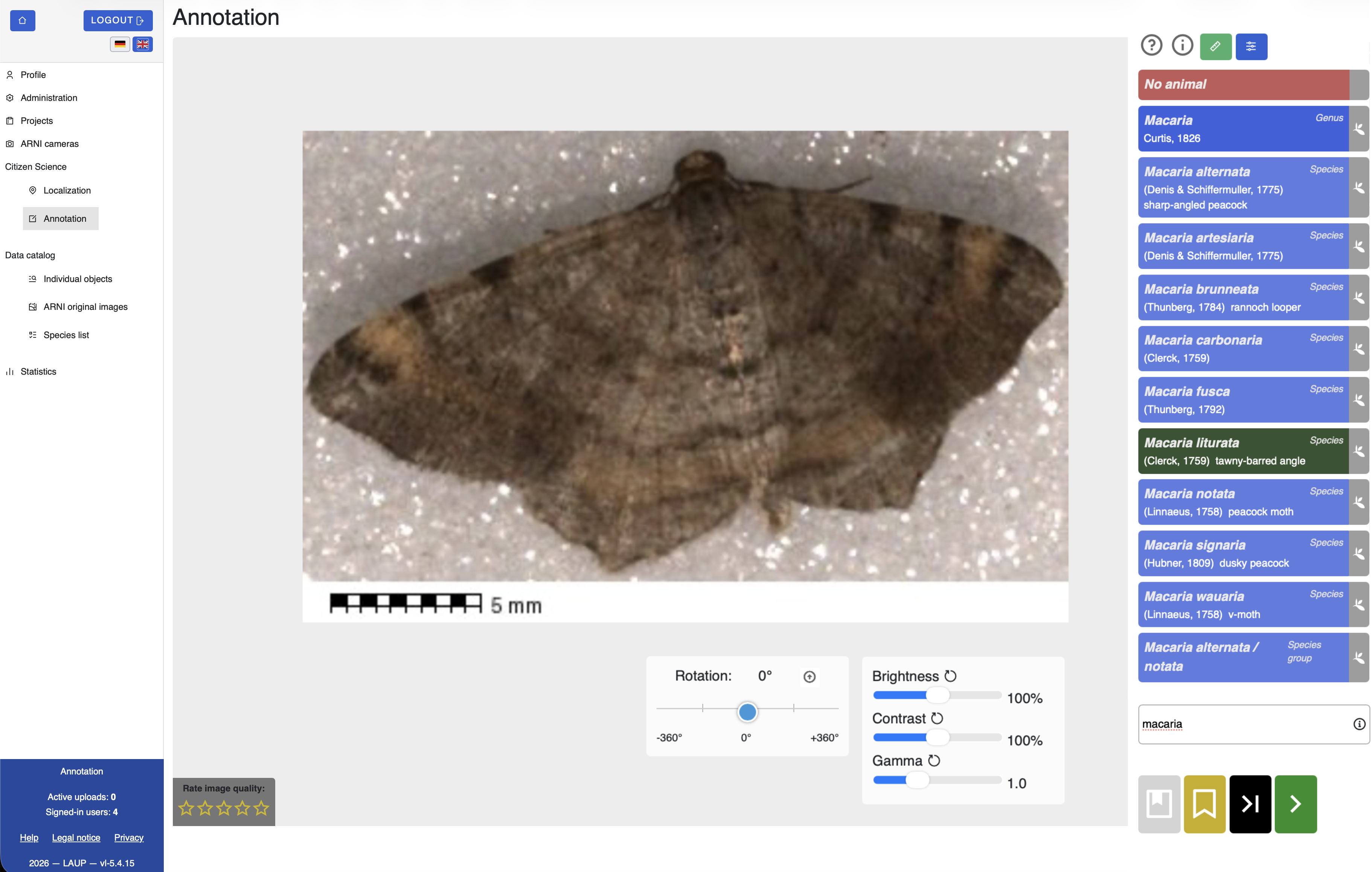
Monitoring insect populations has become an urgent priority given the ongoing biodiversity crisis, and the resulting changes to ecosystem services. However, the available data on insect population trends are severely limited in terms of taxonomic, spatial, and temporal resolution, due to the time-consuming nature of insect collection and identification. The goal of LEPMON (LEPidoptera MONitoring) is to develop a powerful, stable and scalable automated nocturnal insect recording system for long-term monitoring and answering ecological questions. The project runs from December 2024 to November 2027. We provide an overview of the entire project, summarizing the original research proposal and current developments as of August 2026. LEPMON uses time-lapse digital photography of nocturnal insects attracted to a white screen using UV light (LepiLED) with a high resolution of 16 px/mm. Artificial intelligence (AI) is applied for automated processing of the collected images. The recording system comprises two different models of Automated Recorders for Nocturnal Insects (ARNIs). The ARNI-Pro is the high-end model with the highest image quality and durable components, designed for professional users. ARNI-CS is the more affordable and portable alternative with slightly reduced image quality, built largely using 3D-printed components. As of August 2026, 67 ARNI-Pros and 34 ARNI-CS's have been installed in the field. The ARNI-Pro models were set up (1) along eight urbanization gradients to test the system’s ability to detect community changes, and (2) in a variety of natural habitats across Germany to capture as many species as possible, ranging from raised bogs in the north to alpine habitats in the south. We also determine technical limits at extreme locations such as forest canopies and tropical environments and shortly assess the project’s risks and exploitation perspectives. The ARNI-CS models further support the recording of the community composition of nocturnal insects across various habitats in a citizen science context. The images and data generated by the ARNIs are uploaded to a scalable data management platform (LAUP = LEPMON Annotation and Upload Portal). LAUP processes the images and uses AI to enable large-scale object detection and species identification. As accurate AI models require extensive species-labelled training data, large numbers of manually identified images are needed. To obtain these identifications, we involve both taxonomic experts and citizen scientists. We aim to build international collaborations and share knowledge between countries, extending moth monitoring beyond Germany to strengthen LEPMON as a long-term biodiversity monitoring network.
Johann Schmidt, Sebastian Stober, Joachim Denzler, Paul Bodesheim:
PPS: Plug-and-Play Saccadic Vision for Fine-Grained Classification.
British Machine Vision Conference (BMVC).
2026.
[bibtex]
[pdf]
[web]
[abstract]
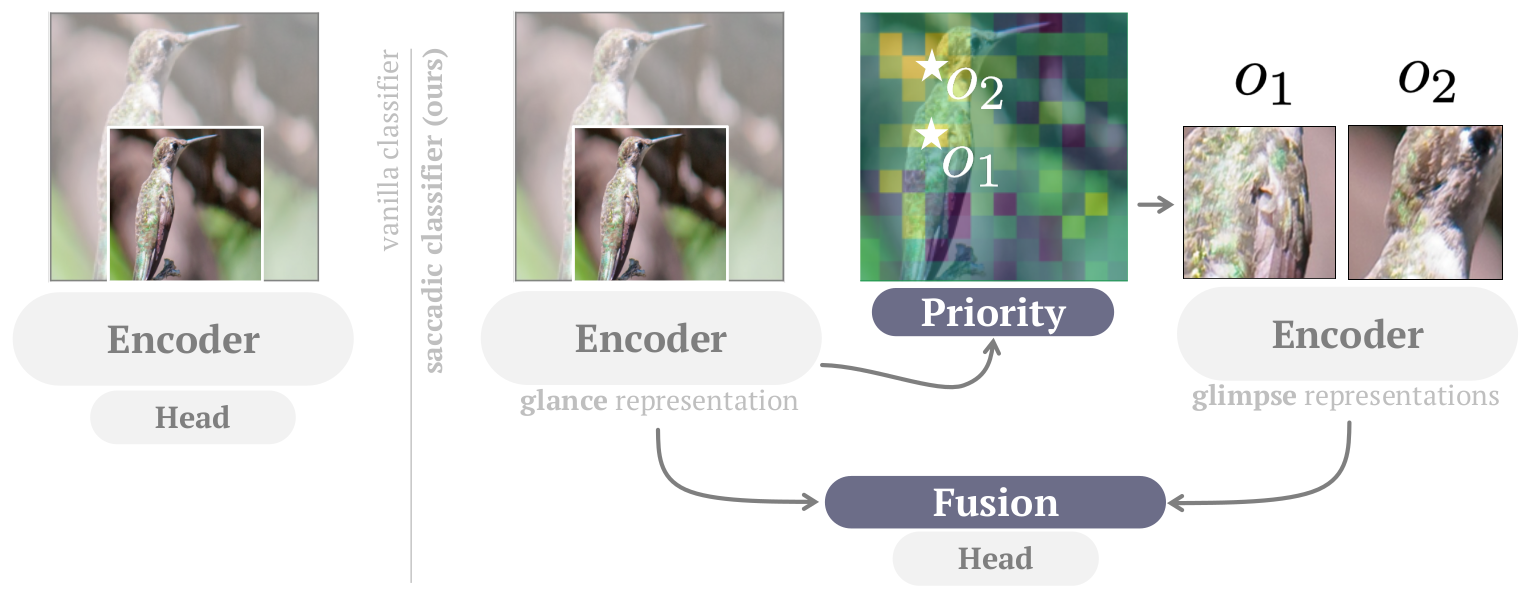
Fine-grained visual classification benefits from high-resolution inputs to resolve subtle, localized cues, but at the cost of large compute and memory budgets. Inspired by human saccadic vision, we propose a lightweight extension that turns any pretrained backbone with spatial feature maps into a saccadic classifier through glimpse-induced inference. The only architectural additions are a small priority head and a single cross-attention fusion block. The same weight-tied encoder encodes a downsampled peripheral glance, exposes the spatial feature map from which the priority head predicts a glimpse-priority distribution and re-encodes high-resolution glimpse crops sampled from that distribution in parallel. A sequential sampler with non-maximum suppression draws a runtime-configurable number of glimpses. A residual multi-head cross-attention block then fuses the glance against the glimpses. To improve the quality of the priority maps, we train the priority head by a per-glimpse information-gain target from a lightweight per-image memory bank. This requires no reinforcement learning. Complexity is linear in the number of glimpses and peak memory is decoupled from input resolution. Across nine benchmarks our framework improves consistently over its backbones.
Peter Grobe, Gunnar Brehm, Paul Bodesheim, Roel van Klink, Julie Koch Sheard, Dennis Böttger, Hui Yu, Corinne Jampou, Christian Bräunig:
Co-Created Insect Monitoring: Combining Automated Sensing, AI, and Citizen Participation for Actionable Biodiversity Data.
World Biodiversity Forum.
2026.
[bibtex]
[pdf]
[web]
[doi]
[abstract]
The LEPMON project is developing a nationwide, standardized monitoring system for nocturnal insects that integrates automated camera light traps (ARNI), a dedicated data platform (LAUP), and AI-supported species identification. Insects are by far the most species-rich animal group with the highest ecological and economic significance, but many studies worldwide show an alarming decline in populations. In addition, individuals can often only be identified by a few experts, and there is a lack of reliable and quantitative studies on the long-term development of populations. Butterflies (Lepidoptera) are one of the most species-rich insect groups, and most species are very good ecological indicators because of their association with specific host plants. With this project, we want to be able to make reliable statements about changes in biodiversity both locally and regionally. To this end, we provide an end-to-end workflow that enables large-scale, continuous, and non-invasive monitoring of biodiversity in a variety of habitats, from heavily urbanized areas to remote canopy environments. During the first field season, LEPMON deployed 42 ARNIs, which generated over 800,000 images in more than 4,600 nightly runs. This demonstrated the system's ability to deliver high-resolution, analyzable data to understand the environmental factors affecting nocturnal insects along urbanization gradients. Citizen science plays a central role in the project's workflow. Volunteers support data collection by running their own ARNIs, providing taxonomic annotations to images, and confirming or correcting AI-generated results. To strengthen long-term engagement and broaden participation, LEPMON is exploring co-creation strategies and user-centered design to improve accessibility and user experience. As part of these efforts, we are evaluating gamification elements—such as progress indicators, contribution summaries, and optional community challenges—that can provide positive feedback and a sense of achievement without creating competitive pressure or compromising data quality. These components are being developed in collaboration with users to ensure that they promote inclusivity, motivation, and scientific relevance. With LEPMON, we want to show how citizen scientists, supported by transparent workflows and well-thought-out engagement strategies, can make a meaningful contribution to ecological research.
Vivian Holzhauer, Dennis Böttger, Paul Bodesheim, Gunnar Brehm:
Do Camera Light Traps for Moths Provide Similar Data as Conventional Funnel Light Traps?.
Insect Conservation and Diversity.
19 (3) :
pp. 498-510.
2026.
[bibtex]
[pdf]
[doi]
[abstract]
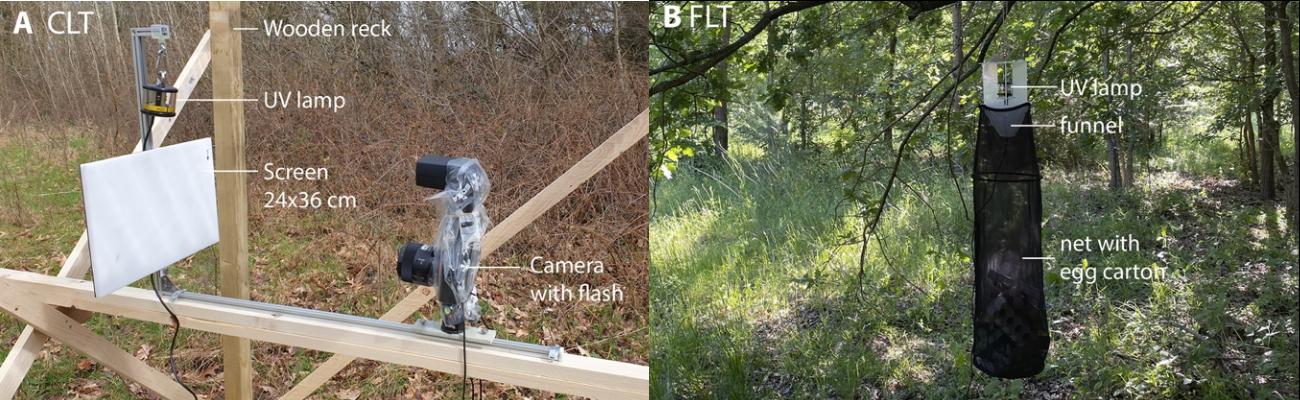
Insects are of crucial importance for terrestrial ecosystems but many populations decline rapidly. Conventional collecting methods are usually time-consuming, resulting in a low temporal, spatial and taxonomic resolution of data. Automated camera light traps (CLT) allow non-lethal monitoring of species-rich moths (Lepidoptera) and other nocturnal insects, but so far little is known about their performance compared to conventional collecting methods.By observing the behaviour of moths in previous field work, we hypothesized that CLT perform well in moth groups in which species tend to sit down quietly after approaching the lamp (such as Geometridae) but worse in moth groups in which species are persistently active (such as Sphingidae).We tested the performance of two CLTs, equipped with Sony alpha 7II (24 megapixel sensor) cameras that resulted in images with approx. 420 dpi resolution. The study was carried out in a forested area near Bielefeld in NW Germany for 196 nights in a row from April to September 2023, and photos were taken every two minutes during the night. All macromoths recognizable in the photos were identified and counted individually. We directly compared the data from the CLTs with moth samples obtained from conventional funnel light traps (FLTs) during 12 nights which were spread across the flight season.The resulting 420 dpi images from the CLTs allowed reliable species identification of all observed macromoths with only few exceptions due to technical problems. In direct comparison during 12 nights, CLTs recorded 39 species exclusively, FLTs recorded 48 species exclusively, and 53 species were recorded by both methods equally. During the whole sampling period of 196 nights in a row, a total of 225 moth species were recorded by CLTs. CLTs tended to record Geometridae better than FLTs whereas Sphingidae tended to be undersampled by the new method. Familes differed in the length to which they remained on the screen of the CLTs.Our study is the first to systematically compare the methods and it shows that CLTs perform overall very well. Results from CLTs differ to a certain extent from conventional trapping methods because they seem to perform worse in groups with highly active species and perform better in calmer groups like geometrid moths. CLTs are promising devices for insect monitoring since they deliver data with high resolution in time, space and taxonomy. The use of artificial intelligence (AI) for the analysis of images is intended as the next logic step.Competing Interest StatementThe authors have declared no competing interest.
Yenny Correa-Carmona, Dennis Böttger, Dimitri Korsch, Kim L. Holzmann, Pedro Alonso-Alonso, Andrea Pinos, Felipe Yon, Alexander Keller, Ingolf Steffan-Dewenter, Paul Bodesheim, Marcell K. Peters, Gunnar Brehm:
LEPY: A Python pipeline for automated trait extraction from standardised Lepidoptera images.
Ecological Informatics.
95 :
pp. 103680.
2026.
[bibtex]
[pdf]
[doi]
[abstract]
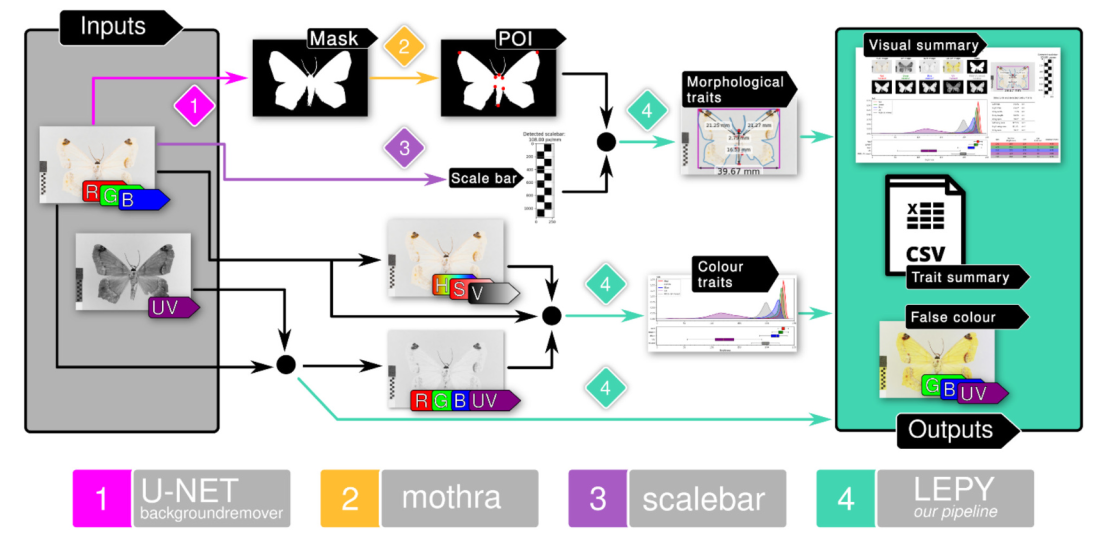
We present LEPY, a free and openly available Python-based pipeline for the automated extraction and analysis of morphological and colour traits, from mounted specimens of Lepidoptera (butterflies and moths). The pipeline uses an automatically detected scale bar for accurate morphological measurements, together with image segmentation that separates the specimen from the background, with users able to pre-select from a set of segmentation models. We designed LEPY to be user-friendly and reproducible, ensuring efficient and consistent analysis of large image datasets. The pipeline also supports the integration of ultraviolet (UV) photographs for improved colour analysis, an innovative feature rarely available in existing trait-analysis tools. LEPY computes morphological traits such as body length, forewing length, and specimen area. It also extracts colour traits including hue, saturation, intensity from the red, green, and blue (RGB) channels, as well as brightness, contrast, chromaticity, and luminance from both RBG and UV channels. The pipeline uses the data to calculate colour diversity with the Shannon index, exports results in a structured, machine-readable format, and it also generates visual summaries of each image pair. We tested LEPY on different moth groups spanning a wide range of body sizes and colouration patterns. As an ecological case study, we applied the pipeline to complete datasets of Sphingidae and Saturniidae collected along an elevational gradient in the Peruvian Andes. The resulting trait data revealed taxon-dependent morphological and colour responses to elevation, thereby demonstrating LEPY's utility for analysing large-scale trait datasets. LEPY provides a robust and fully automated approach for the analysis of morphological and colour traits in Lepidoptera, supporting ecological and evolutionary research. Its scalability and ability to generate standardised, high-resolution trait datasets make it a valuable tool for biodiversity monitoring, macroecological research, and the development of global trait databases.
Hui Yu, Joachim Denzler, Dennis Böttger, Gunnar Brehm, Paul Bodesheim:
Exploiting Unlabeled Images via Pseudo-Labelling and Paste-In Augmentation for Insect Localisation in Automated Monitoring.
International Workshop Series on Camera Traps, AI, \& Ecology (CamTrapAI).
2025.
[bibtex]
[pdf]
[web]
[abstract]
Insect monitoring using an automated deep learning pipeline has become increasingly important in understanding the crisis of insect decline. Advanced model architectures trained with high-resolution images are essential to ensure the quality of insect localisation and species identification. Recent methods struggle with limited annotated data, which requires time-consuming manual labelling for bounding boxes and domain expert-level knowledge for insect categorisation. In this paper, we present a comprehensive benchmark of object detection models for this task, evaluating YOLOv9 and SSD architectures across three distinct datasets: EU-Moths, NID-Moths, and AMI-Traps. Our experiments reveal that high-resolution inputs are a dominant factor for accurate insect localisation, with performance improving substantially with larger image sizes. In addition, we perform cross-dataset validation to verify the generalisation capabilities of YOLOv9 on these datasets, justifying the choice of the AMI-Traps dataset as our pre-training dataset for obtaining a robust detector. Finally, to leverage large amounts of unlabeled data, we investigate a pseudo-labelling and paste-in data augmentation strategy. While this technique provides only modest improvements in overall detection metrics, qualitative analysis demonstrates that it enhances model robustness, enabling the detection of insects in challenging, low-contrast conditions where a strong baseline model would otherwise fail. In our experiments, YOLOv9 outperforms SSD on the one-class NID-Moths and AMI-Traps datasets with average precisions of 0.951 and 0.742, respectively. On the binary-class AMI-Traps dataset, a larger YOLOv9 model with a 1280x1280 input resolution achieves an average precision of 0.972 for the moth category. These results indicate the importance of data-centric approaches and high-resolution imagery for building effective automated insect monitoring systems.