Peter Grobe, Gunnar Brehm, Paul Bodesheim, Roel van Klink, Julie Koch Sheard, Dennis Böttger, Hui Yu, Corinne Jampou, Christian Bräunig:
Co-Created Insect Monitoring: Combining Automated Sensing, AI, and Citizen Participation for Actionable Biodiversity Data.
World Biodiversity Forum.
2026.
[bibtex]
[pdf]
[web]
[doi]
[abstract]
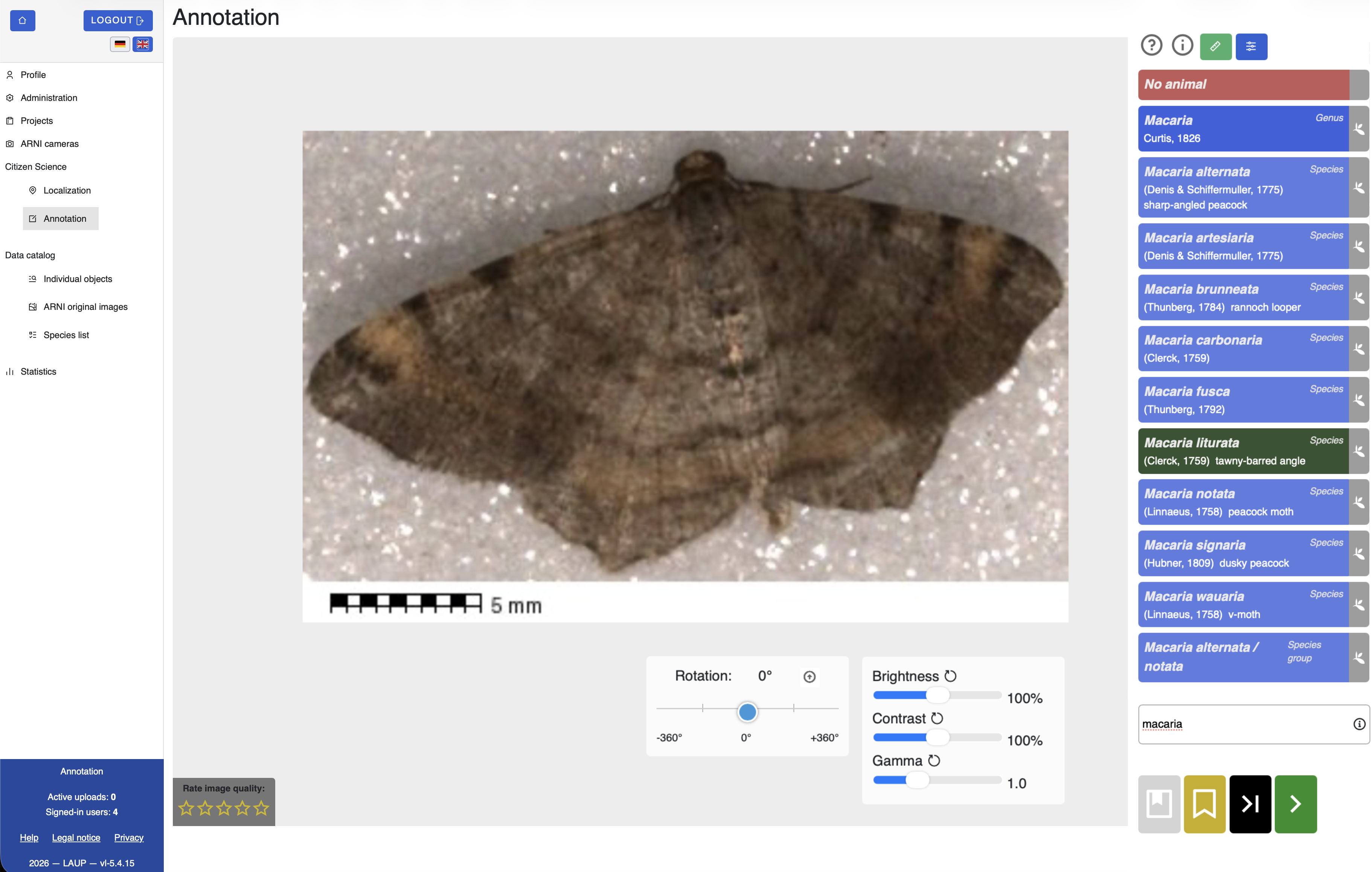
The LEPMON project is developing a nationwide, standardized monitoring system for nocturnal insects that integrates automated camera light traps (ARNI), a dedicated data platform (LAUP), and AI-supported species identification. Insects are by far the most species-rich animal group with the highest ecological and economic significance, but many studies worldwide show an alarming decline in populations. In addition, individuals can often only be identified by a few experts, and there is a lack of reliable and quantitative studies on the long-term development of populations. Butterflies (Lepidoptera) are one of the most species-rich insect groups, and most species are very good ecological indicators because of their association with specific host plants. With this project, we want to be able to make reliable statements about changes in biodiversity both locally and regionally. To this end, we provide an end-to-end workflow that enables large-scale, continuous, and non-invasive monitoring of biodiversity in a variety of habitats, from heavily urbanized areas to remote canopy environments. During the first field season, LEPMON deployed 42 ARNIs, which generated over 800,000 images in more than 4,600 nightly runs. This demonstrated the system's ability to deliver high-resolution, analyzable data to understand the environmental factors affecting nocturnal insects along urbanization gradients. Citizen science plays a central role in the project's workflow. Volunteers support data collection by running their own ARNIs, providing taxonomic annotations to images, and confirming or correcting AI-generated results. To strengthen long-term engagement and broaden participation, LEPMON is exploring co-creation strategies and user-centered design to improve accessibility and user experience. As part of these efforts, we are evaluating gamification elements—such as progress indicators, contribution summaries, and optional community challenges—that can provide positive feedback and a sense of achievement without creating competitive pressure or compromising data quality. These components are being developed in collaboration with users to ensure that they promote inclusivity, motivation, and scientific relevance. With LEPMON, we want to show how citizen scientists, supported by transparent workflows and well-thought-out engagement strategies, can make a meaningful contribution to ecological research.
Hui Yu, Joachim Denzler, Dennis Böttger, Gunnar Brehm, Paul Bodesheim:
Exploiting Unlabeled Images via Pseudo-Labelling and Paste-In Augmentation for Insect Localisation in Automated Monitoring.
International Workshop Series on Camera Traps, AI, \& Ecology (CamTrapAI).
2025.
[bibtex]
[pdf]
[web]
[abstract]
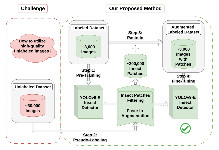
Insect monitoring using an automated deep learning pipeline has become increasingly important in understanding the crisis of insect decline. Advanced model architectures trained with high-resolution images are essential to ensure the quality of insect localisation and species identification. Recent methods struggle with limited annotated data, which requires time-consuming manual labelling for bounding boxes and domain expert-level knowledge for insect categorisation. In this paper, we present a comprehensive benchmark of object detection models for this task, evaluating YOLOv9 and SSD architectures across three distinct datasets: EU-Moths, NID-Moths, and AMI-Traps. Our experiments reveal that high-resolution inputs are a dominant factor for accurate insect localisation, with performance improving substantially with larger image sizes. In addition, we perform cross-dataset validation to verify the generalisation capabilities of YOLOv9 on these datasets, justifying the choice of the AMI-Traps dataset as our pre-training dataset for obtaining a robust detector. Finally, to leverage large amounts of unlabeled data, we investigate a pseudo-labelling and paste-in data augmentation strategy. While this technique provides only modest improvements in overall detection metrics, qualitative analysis demonstrates that it enhances model robustness, enabling the detection of insects in challenging, low-contrast conditions where a strong baseline model would otherwise fail. In our experiments, YOLOv9 outperforms SSD on the one-class NID-Moths and AMI-Traps datasets with average precisions of 0.951 and 0.742, respectively. On the binary-class AMI-Traps dataset, a larger YOLOv9 model with a 1280x1280 input resolution achieves an average precision of 0.972 for the moth category. These results indicate the importance of data-centric approaches and high-resolution imagery for building effective automated insect monitoring systems.